12 Agentic AI Trends Changing How AI Works
Agentic AI is AI that doesn't just answer, it takes actions to reach a goal: it plans steps, uses tools and APIs, checks its own results, and adapts, with limited human hand-holding. A chatbot tells you how to book a flight; an agent books it. The core ingredients you'll see repeated below are a reasoning model, tools and function calling, memory, and orchestration. These are the 12 places agentic AI is actually moving in 2026, and each one gets an honest reality check instead of a hype rating, because half of what gets called "agentic" right now genuinely isn't. If you're still separating "answering" from "acting" in your head, how agentic AI differs from RAG is worth reading first.
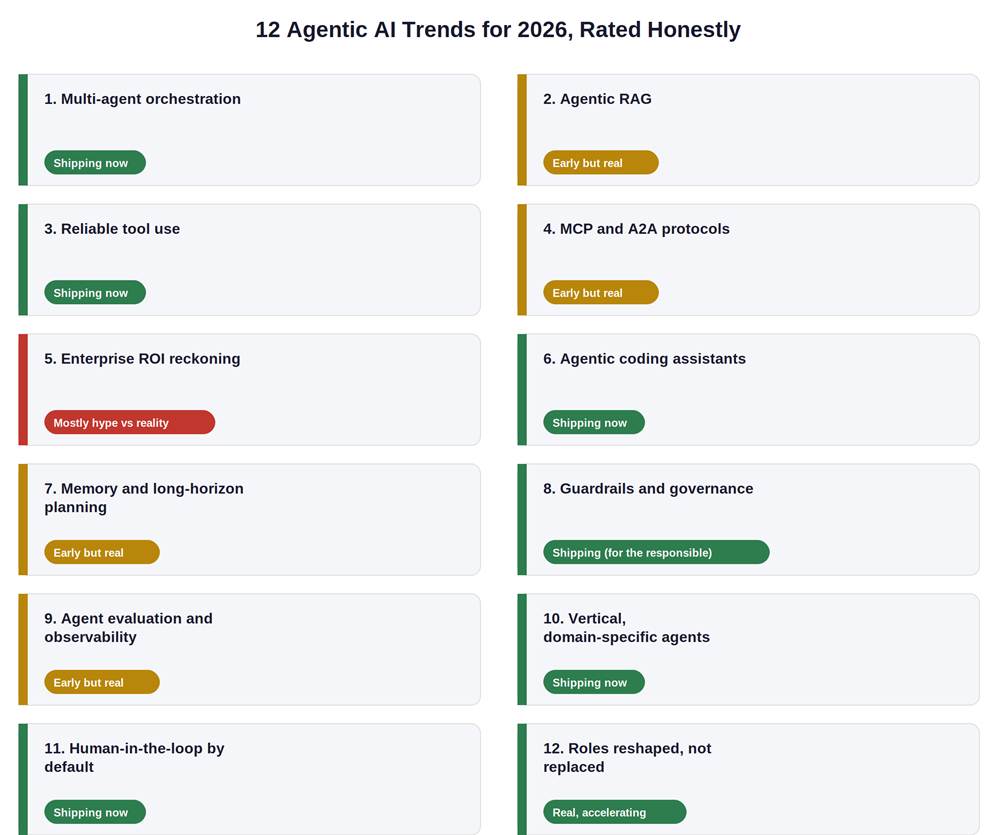
The 12 trends, rated honestly: shipping now, early but real, or mostly hype.
Trend 1: Multi-Agent Systems and Orchestration Go Mainstream
Reality check: Shipping now, in production for narrow tasks, still maturing for complex ones.
Single "do-everything" agents are giving way to teams of specialised agents, a planner, a researcher, a coder, a reviewer, coordinated by an orchestrator. The reason is practical: smaller, role-scoped agents are genuinely easier to control, debug, and evaluate than one giant prompt trying to do everything at once. The tooling behind this is now mature, LangGraph, CrewAI, and AutoGen all ship real orchestration primitives. How agentic AI systems are structured covers the planner-worker pattern in depth. Honest caveat: coordination overhead is real, more agents means more failure points and more cost, so the most reliable production systems still keep the agent graph deliberately small.
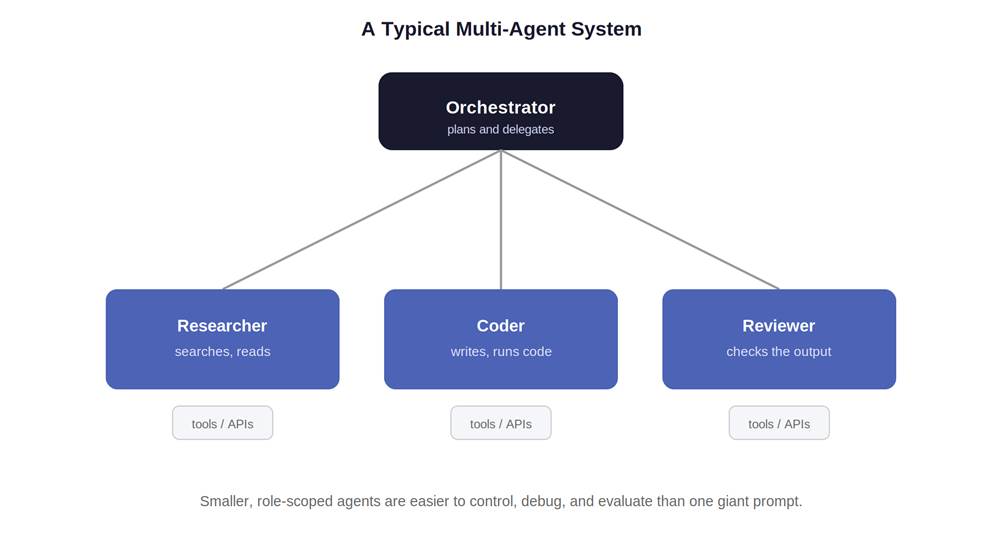
A typical multi-agent system: an orchestrator delegating to role-scoped workers.
Trend 2: Agentic RAG Replaces One-Shot Retrieval
Reality check: Early but real, clearly better than plain RAG, still settling into best practices.
Classic RAG retrieves once and generates. Agentic RAG lets the agent decide when to search, re-query if the first results are weak, pull from multiple sources, and verify before answering. This fixes RAG's biggest failure mode: answering confidently off bad or missing context. A concrete example: a research agent that notices its first retrieval was low-relevance and reformulates its own query before trying again, rather than answering anyway. How retrieval works inside AI agents covers the mechanics in more depth.
Trend 3: Tool Use and Function Calling Become Reliable
Reality check: Shipping now, this is the backbone of every real agent.
The thing that actually turns a language model into an agent is the ability to call tools, APIs, databases, code execution, web search. In 2026 this has gone from flaky to genuinely dependable: structured outputs, parallel tool calls, and much better error handling. The mechanism is plain once you see it once: the model emits a structured "call this function with these arguments," your code runs it, and the result goes back into the model's context. Honest note: tool selection is still where agents fail most often, they call the wrong tool, or they hallucinate an argument that looks plausible and isn't. Parallel tool calling in particular has matured fast this year, letting an agent fire off several independent lookups at once instead of waiting on each one sequentially, which is a meaningful chunk of why agents feel noticeably faster in 2026 than they did even a year earlier.
Build an AI-First Career, Master the Complete Skillset
Choose from our industry-leading programs designed for career success
Modern Software and AI Engineering Program
Master full-stack development with AI integration


 +1000 more
Modern Data Science and ML with specialisation in AI
Advanced data science techniques with AI specialization
+1000 moreAdvanced AIML with Specialisation in Agentic AI
Deep dive into AIML with focus on Agentic systems
+1000 moreDevOps, Cloud & AI Platform Engineering
Build and manage AI-powered cloud infrastructure
+1000 moreAI Engineering Advanced Certification by IIT-Roorkee
Premier AI engineering certification from IIT-Roorkee

AI Forward Deployed Engineer Program
Full-stack engineering, production AI and client-facing consulting
+1000 moreTrend 4: Agent Protocols (MCP and A2A) Standardise How Agents Connect
Reality check: Early but real, adoption is climbing fast, the standards are still forming.
Every agent-to-tool and agent-to-agent integration used to be custom glue code. The Model Context Protocol gives agents a standard way to plug into tools and data sources, and its own documentation describes it plainly as trying to be the "USB-C for AI applications," now with broad support across Claude, ChatGPT, VS Code, and Cursor. Separately, agent-to-agent (A2A) efforts aim to let agents from different vendors talk to each other directly. Honest caveat: it's genuinely early, competing standards, uneven support across vendors, and real open security questions about what an agent is actually allowed to touch once it's connected.
Trend 5: Enterprises Hit the ROI Reality Check
Reality check: Mostly hype meeting hard reality, 2026 is the "prove it" year.
This is the honesty centrepiece of this whole page. Adoption pilots exploded through 2024 and 2025. Gartner's own June 2025 prediction, still the most-cited figure in this space heading into 2026, is that over 40 percent of agentic AI projects will be canceled by the end of 2027 due to escalating costs, unclear business value, or inadequate risk controls. Gartner's own analysts coined the term "agent washing" for vendors rebranding ordinary chatbots and RPA tools as agentic without real agentic capability, and estimated at the time that only around 130 of the thousands of agentic AI vendors were doing anything genuinely agentic. Gartner's 2026 Hype Cycle now places agentic AI at the Peak of Inflated Expectations. The pattern holds up across other research too: Forrester's mid-2026 reporting found roughly three-quarters of enterprise leaders claim to have adopted agentic AI, while only a small minority have anything running in meaningful production beyond what the report calls "agentish chatbots." Why agents are hard to productionise isn't a mystery: non-determinism, edge cases, permissions, and monitoring are all genuinely harder than the demo made them look.
| Where enterprise agents work today | Where they still stumble |
|---|---|
| Narrow, well-scoped tasks with clear success criteria | Broad "autonomous everything" mandates with vague goals |
| Internal tools with forgiving failure modes | Customer-facing actions with real financial or legal risk |
| Processes already well-documented and structured | Legacy systems with messy, undocumented integrations |
| Teams that measure and iterate on real ROI | Pilots sold on the demo, never re-evaluated after launch |
The honest bottom line: the winners are narrow, well-scoped agents with measurable ROI, not "autonomous everything." Real-world agent use cases is worth reading for concrete examples of exactly that narrow, working kind.
Trend 6: Agentic Coding Assistants Graduate From Autocomplete to Teammates
Reality check: Shipping now, the most economically real agentic use case so far.
Tools like GitHub Copilot's agent mode, Cursor, and Claude Code have moved from suggesting the next line to taking an actual ticket, editing across multiple files, running tests, and opening a pull request. What changed is the combination of better long-context reasoning, reliable tool use, and genuine repo awareness, not any single breakthrough. Honest caveat: they still need real review, they struggle on large, unfamiliar codebases, and "vibe coding" without actually understanding what got generated quietly creates maintenance debt that shows up months later. How AI is changing software development covers what this shift actually means day to day. Practical framing worth sitting with: this raises the bar for what a junior engineer needs to bring, judgment and system understanding, not just syntax.
Trend 7: Memory and Long-Horizon Planning Get Serious
Reality check: Early but real, this is the current frontier, not a solved problem.
An agent that forgets everything between steps can't do genuinely multi-step work. The 2026 push is toward persistent memory, both short-term scratchpads and long-term stores, and planning over longer horizons without losing the thread partway through. Two problems, stated plainly: remembering the right things, and staying on task across many steps without drifting. Honest note worth sitting with: this is genuinely unsolved at scale. Agents still drift, loop, or quietly lose the original goal on long tasks. This is where real research is happening, not marketing copy. Practically, this shows up as agents that summarise and compress their own history rather than trying to hold every prior step in context, and as separate long-term memory stores, often vector databases, that get queried only when something from a past session is actually relevant to the current one.
Trend 8: Guardrails, Governance and Safety Move From Optional to Mandatory
Reality check: Shipping now for the responsible teams, ignored by the reckless ones.
When an agent can actually act, spend money, send emails, change records, a hallucination stops being an embarrassment and becomes an incident. The real guardrail layers: permission scoping on the principle of least privilege, approval gates for anything genuinely risky, input and output validation, and sandboxing for anything that executes code. Regulation is shaping this too, the EU AI Act and internal AI governance policies now directly constrain what agents are allowed to do autonomously in a growing number of organisations. Honest framing worth saying plainly: most teams under-invest here until something actually breaks, and only then take it seriously.
Trend 9: Agent Evaluation and Observability Become a Discipline
Reality check: Early but real, and the skill gap here is genuinely huge.
You can't ship what you can't measure. 2026 is seeing real tooling emerge for tracing an agent's steps, logging every tool call, scoring task success, and catching regressions, the "agent ops" layer the field badly needed. It's hard for a specific reason: agents are non-deterministic, so classic pass/fail unit tests don't fit the way they do for normal code. You end up evaluating trajectories and outcomes, not just outputs, which means asking whether the agent's reasoning path made sense, not just whether the final answer happened to be right. Practical tip worth acting on: knowing how to evaluate an agent properly is quietly one of the most hireable agentic skills right now, precisely because so few people can actually do it well, and it's exactly the skill that separates a demo that impresses a room from a system a company will actually trust in production.
Trend 10: Vertical, Domain-Specific Agents Outperform General Ones
Reality check: Shipping now, and this is where the real business value actually lives.
General "assistant" agents impress in demos. Narrow agents win in production, a claims-processing agent, a legal-review agent, a customer-support agent trained tightly on one company's own documentation. The reason is straightforward: constrained scope means better data, tighter guardrails, measurable ROI, and fewer ways for things to go wrong. This shows up across support, coding, finance, healthcare, and sales alike. Honest tie-back to the ROI reckoning above: this is exactly why the narrow bets are the ones actually returning money, while the broad, ambitious ones are the ones getting quietly canceled.
How Scaler Transformed Careers in Different Fields
Scaler learners achieved 2.5x salary growth with average post-Scaler CTC reaching ₹23L.
 Google
 Amazon
 Microsoft
 Flipkart
 Adobe1200+ more
Trend 11: Human-in-the-Loop Becomes the Default Design Pattern
Reality check: Shipping now, and it's a feature, not a failure.
Fully autonomous agents grab the headlines. Reliable systems keep a human at the decision points that actually matter. The real patterns: approval gates before anything consequential, confidence thresholds that escalate uncertain cases to a person, human review of agent output before it ships, and the general shape of "agent proposes, human disposes." The honest, mature 2026 take isn't "agents replace humans," it's "agents draft, humans decide," especially anywhere the cost of a wrong action is genuinely high. This connects directly back to Trend 8, since a well-placed approval gate is often the single cheapest guardrail a team can add, and to Trend 5, since the enterprise pilots that survived the ROI reckoning are disproportionately the ones that kept a human in the loop deliberately rather than promising full autonomy from day one.
Trend 12: Agentic AI Reshapes Roles, Not Just Tasks
Reality check: Real and accelerating, but slower and messier than the headlines suggest.
New roles are emerging, AI engineer, agent or AI-workflow engineer, AI product roles, while routine execution work compresses. Said honestly and without alarm: agents automate tasks, and a job is a bundle of tasks, so the people who thrive are the ones who move up the stack toward orchestration, judgment, and system design rather than pure execution. The skills an AI engineer needs today names exactly what that shift looks like in practice.
What These Trends Mean for Your Career
If you're a student or beginner: start with fundamentals, Python, how LLMs actually work, basic prompting, before jumping straight to agents. Then learn to build a simple agent with tools. Don't skip the basics chasing the exciting part. A step-by-step agentic AI roadmap lays out exactly that order.
If you're a working engineer: the real leverage is in orchestration, tool integration, evaluation, and guardrails, the "make it actually reliable" skills, not just calling an API and hoping. These are precisely the skills Trends 1, 8, and 9 above are pointing at directly, and they're also the skills that don't go stale the moment the next model release changes what a raw LLM can do on its own.
The skills that compound regardless of where you start: agentic RAG, MCP and tool use, multi-agent design, agent evaluation, and, just as importantly, the judgment to know when not to automate something at all. What an agentic AI curriculum covers lists the concrete topics behind that list if you want to plan your own learning against it.
Video: Complete Agentic AI Roadmap 2026 | Skills & Salary | AI Agents Course — walks through this exact skills-and-order arc plus a current salary read, if you'd rather watch the path than read it.
FAQs
Turn Learning into Career Growth
What is the biggest agentic AI trend in 2026?
Multi-agent orchestration and agentic coding assistants are the two most economically real trends right now, both are genuinely shipping in production, not just demoed.
Is agentic AI overhyped?
Partly, and it's worth being honest about which part. It's real in narrow, well-scoped uses. It's overhyped as "fully autonomous everything." Gartner's own ROI reality check on enterprise projects backs this up directly.
What is the Model Context Protocol (MCP)?
A standard that lets AI agents connect to tools and data sources in a consistent way, rather than needing custom integration code for every connection. MCP's own documentation describes it as the "USB-C for AI applications."
Will agentic AI replace software engineers?
No. It automates tasks, not judgment. It shifts engineers toward orchestration, review, and system design, and raises the bar on what a junior engineer needs to bring beyond just writing syntax.
What skills do I need to work with agentic AI in 2026?
Python fundamentals, a working grasp of how LLMs behave, tool use and function calling, agent evaluation, and guardrails. The judgment to know when an agent is the wrong tool for a task matters just as much.
What's the difference between AI agents and agentic AI?
An AI agent is typically one autonomous actor completing a task. Agentic AI is the broader paradigm, often involving multiple agents coordinating together through an orchestrator, as covered in Trend 1 above.
Are enterprises actually using agentic AI?
Yes, but selectively. Narrow, well-scoped production agents are succeeding and returning real value. Broad, ambitious autonomous pilots are the ones stalling, with Gartner projecting over 40 percent canceled by the end of 2027.
These trends all point the same way: the people who thrive won't just use agents, they'll understand how to build, evaluate, and govern them. If you want to go from reading about agentic AI to building it, explore Scaler's AI & Machine Learning program and its structured, project-based path into AI engineering.