Conversational AI vs Generative AI: What's the Difference?
Conversational AI is any system built to understand and respond in natural, back-and-forth dialogue, think chatbots and voice assistants. Generative AI is any model built to create new content, text, images, audio, or code. They overlap because modern chatbots increasingly use generative AI under the hood, but they're answering different questions. One is about talking naturally. The other is about making something new. If you're also untangling this from a third overlapping term, how generative AI differs from predictive AI covers that specific comparison.
What Is Conversational AI?
Conversational AI is the set of technologies that let a machine hold a natural-language conversation, understanding what a user means and responding usefully, whether typed or spoken. IBM's own explainer on the topic frames it the same way, and it's worth reading as a vendor-neutral second opinion on the definition.
The Core Technologies Behind It
Natural language understanding (NLU) figures out what the user actually means. Intent recognition maps that meaning to a known category of request. Dialogue management decides what happens next in the conversation. For voice specifically, speech recognition turns audio into text, and text-to-speech turns the reply back into audio. The NLP that powers language understanding goes deeper on the NLU piece if you want the foundational mechanics.
Build an AI-First Career, Master the Complete Skillset
Choose from our industry-leading programs designed for career success
Modern Software and AI Engineering Program
Master full-stack development with AI integration


 +1000 more
Modern Data Science and ML with specialisation in AI
Advanced data science techniques with AI specialization
+1000 moreAdvanced AIML with Specialisation in Agentic AI
Deep dive into AIML with focus on Agentic systems
+1000 moreDevOps, Cloud & AI Platform Engineering
Build and manage AI-powered cloud infrastructure
+1000 moreAI Engineering Advanced Certification by IIT-Roorkee
Premier AI engineering certification from IIT-Roorkee

AI Forward Deployed Engineer Program
Full-stack engineering, production AI and client-facing consulting
+1000 moreEveryday Examples
Amazon Alexa, Apple Siri, Google Assistant, customer-support chatbots, and IVR phone menus that route your call by asking you to "press 1 for billing." Worth knowing: older conversational AI was rule-based or intent-matching, and it generated nothing at all. It matched your words to a script someone wrote in advance.
What Is Generative AI?
Generative AI models learn patterns from huge datasets and use them to produce new content that didn't exist before, a paragraph, an image, a song, a block of code. The mechanism, lightly: foundation models, usually large language models, get trained on enormous amounts of data, and then a prompt goes in and freshly generated content comes out. How generative AI actually creates content is the deeper companion piece if you want the full mechanics behind that one sentence.
Everyday Examples
ChatGPT and Google Gemini for text, Midjourney and DALL-E for images, code assistants for, well, code, and various voice or music generators for audio. Generation is the defining act here. If nothing new gets created, it isn't generative AI, whatever else it might be doing. Google Cloud's own overview of generative AI is worth a look too, since it's written from the vendor actually building the foundation models behind Gemini.
Conversational AI vs Generative AI: The Key Differences
The cleanest way to frame this: conversational AI is defined by a purpose, holding natural dialogue. Generative AI is defined by a capability, creating new content. They're not really competing on the same axis, which is exactly why "vs" is a slightly misleading way to frame the question in the first place. Think of it less like choosing between two rival products and more like comparing "a car's destination" against "the engine that gets it there," they're answering different kinds of questions entirely.
| Dimension | Conversational AI | Generative AI |
|---|---|---|
| Primary purpose | Understand and respond in natural dialogue | Create new, original content |
| What it produces | A relevant response or action in a conversation | New text, images, audio, video, or code |
| Core technology | NLU, intent recognition, dialogue management, speech | Foundation models / LLMs, deep learning |
| Typical input to output | User's spoken or typed message to a fitting reply | A prompt to a freshly generated artifact |
| Interaction style | Two-way, turn-by-turn dialogue | Often one prompt to one large output |
| Examples | Alexa, Siri, IVR, support chatbots | ChatGPT, Gemini, Midjourney, DALL-E |
Same idea in prose, since a table alone can feel a bit clinical: conversational AI is the goal, generative AI is the tool increasingly used to reach it. For the wider family of AI terms this sits inside, the broader difference between AI and generative AI zooms out a level further.
Where Do They Overlap? Why the Line Is Blurring
This is the part most explainers fumble, so let's be direct about it. For years, conversational AI was rule-based and generated nothing, it matched your words to a script and picked the closest pre-written reply. Then generative models, specifically LLMs built on the transformer architecture, got genuinely good, and chatbot builders started using them to generate a fresh reply instead of retrieving a canned one. The original transformer paper, published by Vaswani and colleagues in 2017, is the actual research behind almost every model doing that generating today, ChatGPT included. So a modern assistant is often both at once: conversational AI in its purpose, holding a dialogue, and generative AI in its actual engine, since it generates each response on the fly. ChatGPT is the clearest example of this, a generative model wrapped in a conversational interface. Large language models is the foundational piece if you want to understand the actual technology doing the generating.
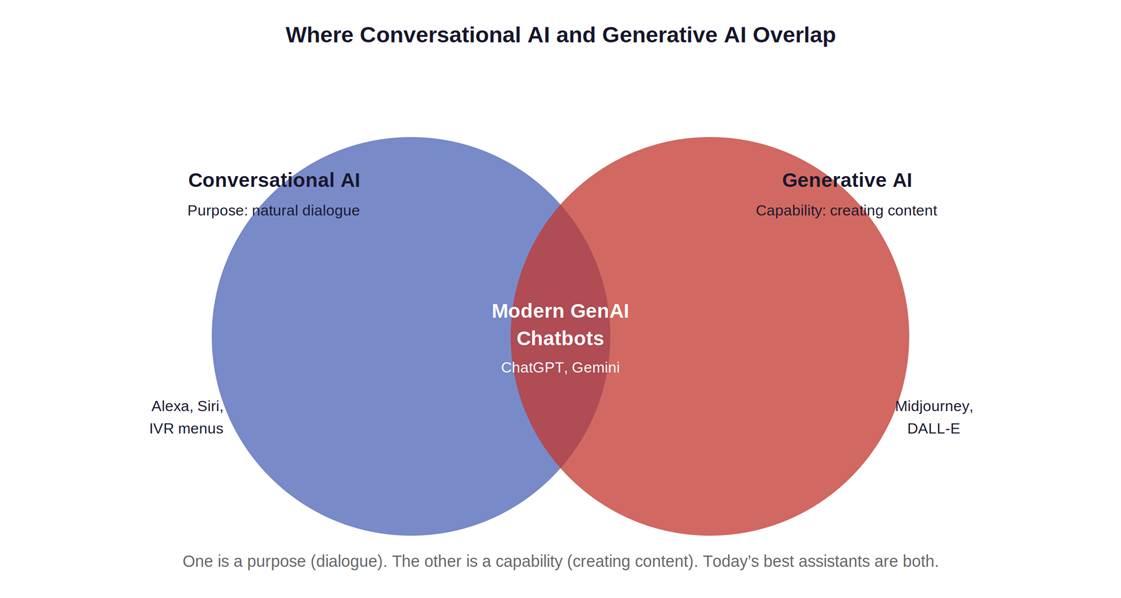
Modern GenAI chatbots sit in the overlap: conversational in purpose, generative in engine.
The takeaway worth actually remembering: the two aren't rivals. Increasingly, generative AI is simply how the best conversational AI gets built.
How Scaler Transformed Careers in Different Fields
Scaler learners achieved 2.5x salary growth with average post-Scaler CTC reaching ₹23L.
 Google
 Amazon
 Microsoft
 Flipkart
 Adobe1200+ more
When Should You Use Each One?
Reach for conversational AI when the job is dialogue: customer support bots, voice assistants, appointment or booking flows, IVR call routing, in-app help, anywhere a user needs a natural back-and-forth to actually get something done.
Reach for generative AI when the job is creation: drafting marketing copy, generating images or product mockups, summarising long documents, writing or reviewing code, producing synthetic data for testing.
Reach for both together when you want a genuinely smart assistant: a support bot that generates tailored answers straight from your help docs instead of picking from five canned replies, or an AI tutor that holds a real conversation and creates fresh examples on the spot. This combined approach is where most modern products are actually heading, and it's the natural stepping stone into how AI agents build on these ideas, systems that go a step further and take action, not just talk.
Conversational AI vs Chatbot: Are They the Same Thing?
No, and this trips people up constantly. A chatbot is one application of conversational AI, not a synonym for the whole field. Simple chatbots follow decision-tree rules, click this button, get that canned reply, nothing more sophisticated underneath. Conversational AI is the broader field of systems that understand natural language and manage a dialogue, and it also powers voice assistants, not just text-based bots on a website. Modern "AI chatbots," the generative kind everyone means today, sit at the intersection of all three ideas at once: they're chatbots in form, conversational AI in purpose, and generative AI in how they actually produce each reply.
FAQs
Turn Learning into Career Growth
What is the main difference between conversational AI and generative AI?
Purpose versus capability. Conversational AI exists to hold natural dialogue. Generative AI exists to create new content. A system can do one, the other, or both at once.
Is ChatGPT conversational AI or generative AI?
Both. It's a generative model, an LLM that produces new text, wrapped in a conversational interface that manages the back-and-forth dialogue with you.
Is conversational AI the same as a chatbot?
No. A chatbot is one specific application of conversational AI. Conversational AI is the broader field, and it also covers voice assistants and other dialogue systems beyond just text-based bots.
Can conversational AI use generative AI?
Yes, and increasingly it does by default. Modern chatbots and voice assistants use LLMs to generate each reply fresh, rather than retrieving a pre-written response from a fixed script.
Are Alexa and Siri generative AI?
Traditionally no, they're mostly intent-based conversational AI matching your request to a known action. Newer versions of both are adding generative features on top of that base.
Which is better, conversational AI or generative AI?
Neither, they solve different problems entirely. Pick based on the task: dialogue calls for conversational AI, creating something new calls for generative AI, and many modern products genuinely need both.
Curious how generative AI actually works under the hood, and how to build with it? Explore Scaler's generative AI roadmap for a step-by-step path from the basics to real projects.