


Difference Between Stack and Queue Data Structures
 FREE
FREE

Overview
There are many data structures like arrays, linked lists, and trees that are used to organise the data in a particular manner. Stack and queue are also considered fundamental data structures, and both are organized in a linear form where elements are arranged in a specific sequence,and understanding how these data structures interact is especially important in the context of synchronization hardware in operating systems.
A stack and a queue are two other data structures that are used to organise data. Both of them are linear data structures, which means they store and retrieve the elements in a sequencial manner from the structure when required.
Stack follows the LIFO (Last In First Out) order to store the elements whereas the Queue follows the FIFO (First In First Out) order to store the elements in the memory.
We'll take a deepr look at the difference between stack and queue.
Takeaways
- Stack and Queue are non-primitive, linear data structures.
- Difference between Stack and Queue
What is a Stack Data Structure?
A stack is a non-primitive, linear data structure that stores the elements in a LIFO (Last In First Out) order. However, the stack can only be used to store similar kinds of elements, that is, those that have the same data types.Understanding how these data structures interact with DBMS architecture can help in designing efficient database systems.
An example of a stack data structure could be a pile of books that are kept on a table. You can imagine how the books would be placed on top of each other. However, the topmost book, which would have been kept at last, is the one that will be removed first from the pile. Therefore, it follows the Last In First Out order.
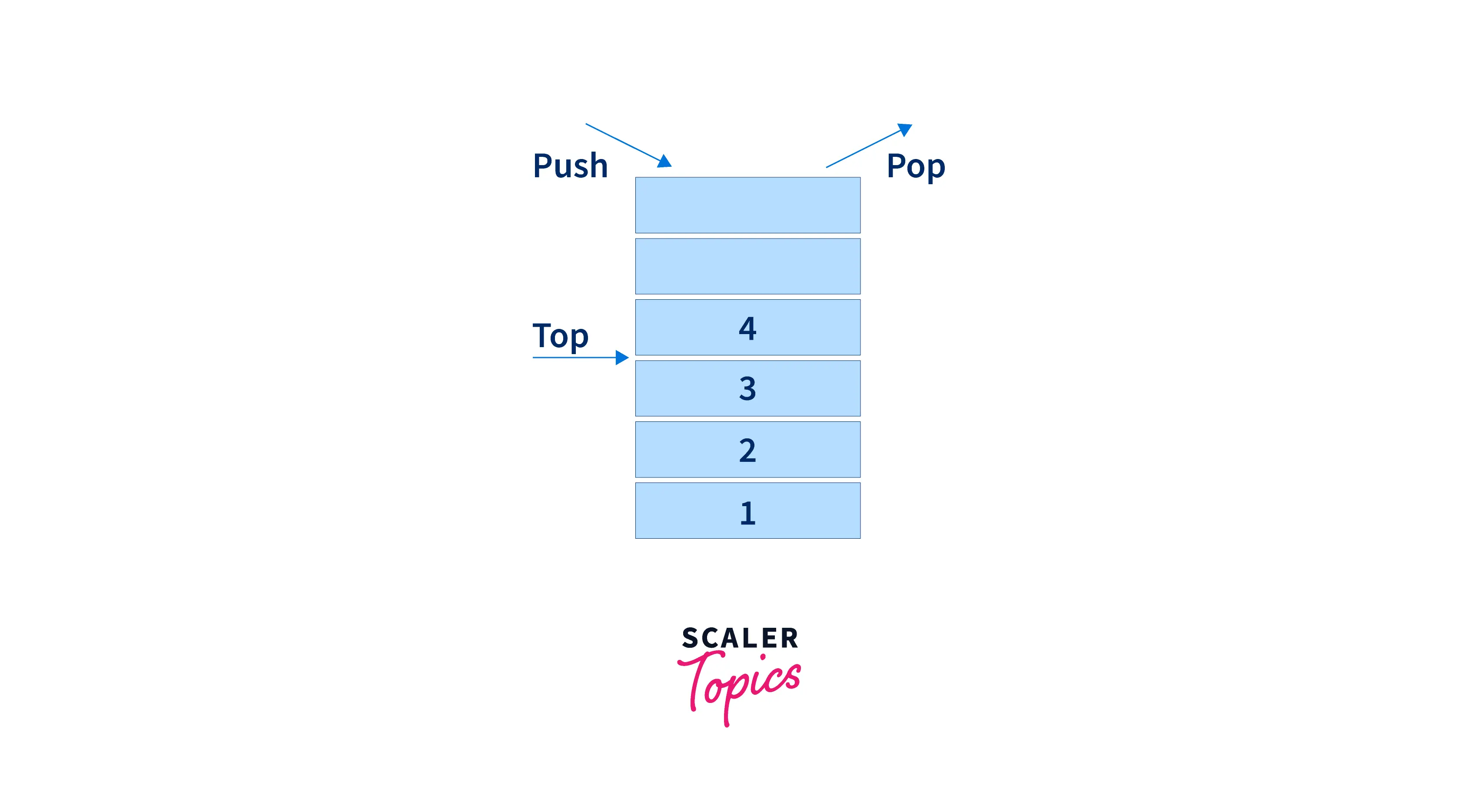
The basic operations of a stack are the push operation and the pop operation. There are multiple operations that are performed on the stack elements like insertion, deletion, finding the peek element, and determining whether the stack is empty or not. The insertion in a stack is called a push operation, whereas the deletion in a stack is called a pop operation.
However, the insertion and deletion from the stack could be done from one end only. It has a single pointer called top which points to the topmost element of the stack and insertion as well as deletion is performed by manipulating the top pointer only. Insertion and deletion in the stack have a time complexity of O(1).
You can refer to the article Stacks in Data Structure for more information about stacks or visit types of attributes in DBMS for a deeper understanding of attributes.
Common applications of stacks include expression evaluation and backtracking algorithms, where the stack's LIFO property is essential for managing recursive calls and parsing expressions.
What is a Queue Data Structure?
A queue is also a non-primitive, linear data structure that stores elements in a sequential manner. However, the queue data structure follows a FIFO (First In First Out) order to store and retrieve elements from the memory. It can also only store similar kinds of elements in the queue.
An example of a queue can be a line or a queue in a bank in which the person who comes first will be served first. Therefore, it follows the FIFO order to process the elements.
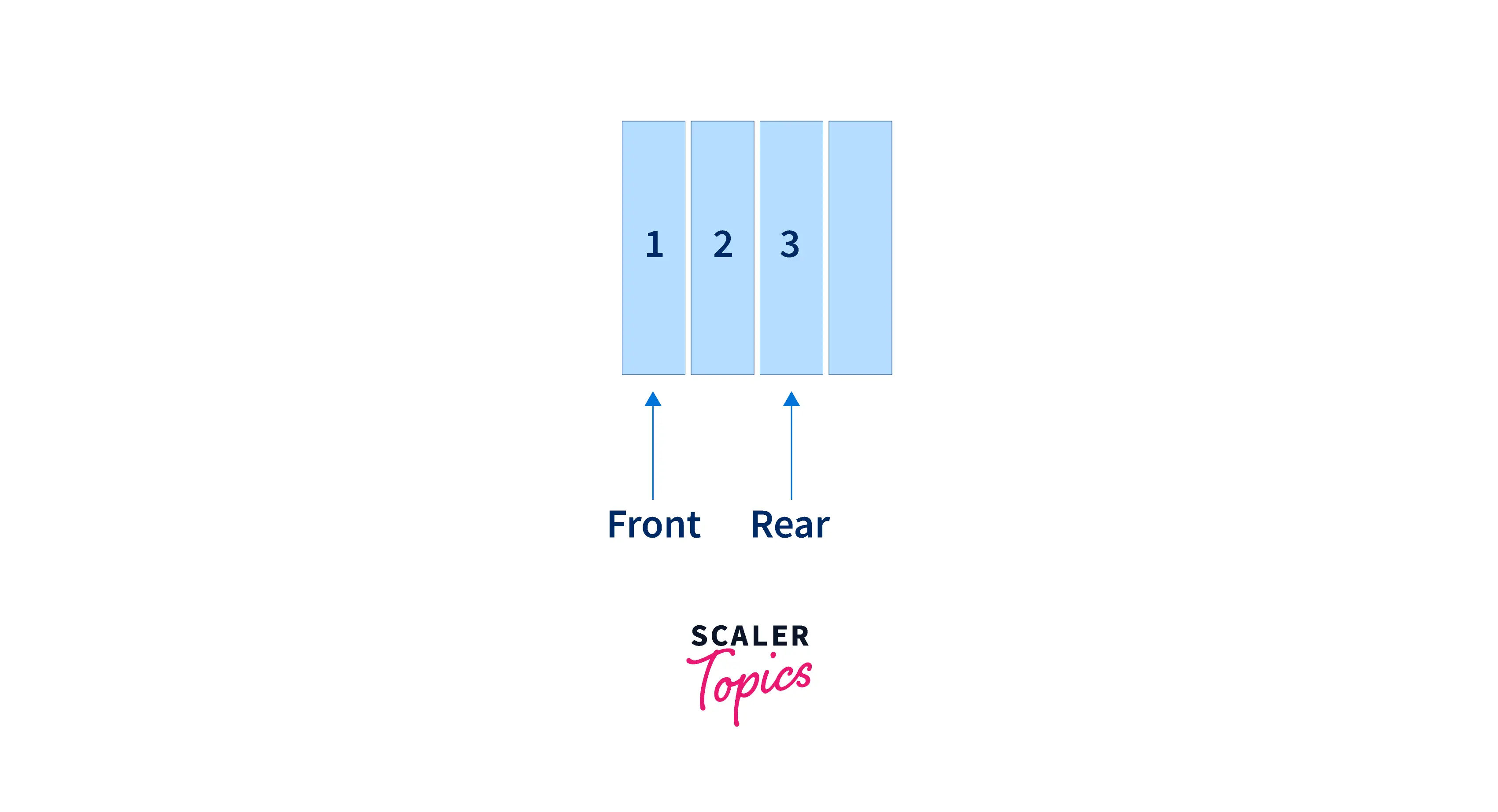
Similar to Stacks, they are also used to perform insertions, and deletions, find the peak element, and check whether the queue is empty or not. However, insertion into a queue is called enqueue, whereas deletion from a queue is called dequeue.
There are two pointers in a queue, known as the rear and front. The rear points to the last element, whereas the front points to the first element that is inserted into the queue. Therefore, an element is inserted into a queue using the rear pointer, whereas the element is deleted using the front pointer. The time complexity for insertion and deletion in the queue is O(1).
However, there are other types of queue that give the facility to insert and delete from both ends of the queue.
Memory Efficiency
When considering memory efficiency in stack and queue data structures, the choice of implementation plays a significant role. A stack data structure, as a linear data structure, can be implemented using either an array or a linked list. With an array-based stack, memory space is allocated in advance, which can sometimes lead to unused memory if the stack does not reach its maximum capacity. This approach may result in less optimal memory utilization, especially when the number of elements stored fluctuates.
On the other hand, implementing a stack using a linked list allows for dynamic memory allocation. Here, memory is allocated only when a new element is pushed onto the stack, making it more memory-efficient, especially for applications where the stack size changes frequently.
For a queue data structure, memory efficiency can be further improved by using a circular buffer. A circular buffer enables the queue to reuse memory space that becomes available when elements are dequeued, preventing the need to shift elements and making the most of the allocated memory. This approach is particularly useful in scenarios where the queue operates continuously, such as in streaming data or real-time processing.
In summary, both stack and queue data structures can be optimized for memory efficiency by choosing the right implementation—linked lists for dynamic allocation and circular buffers for efficient reuse of memory space.
Linked List Implementation
A linked list implementation is a versatile and efficient way to handle stack and queue data structures. In the case of a stack, the linked list approach uses a single pointer to keep track of the topmost element. When performing push and pop operations, the pointer is updated to reflect the addition or removal of nodes, ensuring that the most recently added element is always accessible at the top. This method allows for efficient memory management, as memory is allocated only when needed and released when elements are removed.
For a queue, the linked list implementation involves two pointers: one pointing to the front element and the other to the rear. The enqueue operation adds a new node at the rear, while the dequeue operation removes the node from the front. By updating these two pointers, the queue can efficiently handle data in a first-in, first-out manner without the need to shift elements, as would be required in an array-based implementation.
Using a linked list for stack and queue data structures not only provides dynamic memory allocation but also simplifies memory management, especially when the number of elements is unpredictable. This approach is widely used in programming languages and systems where flexibility and efficient use of memory are important.
Difference Between Stack and Queue Data Structures
| Parameters | Stack | Queue |
|---|---|---|
| Working Principle | It follows the LIFO (Last In First Out) order to store the elements, which means the element that is inserted last will come out first. | It follows the FIFO (First In First Out) order to store the elements, which means the element that is inserted first will come out first. |
| Pointers | It has only one end, known as the top, at which both insertion and deletion take place. | It has two ends, known as the rear and front, which are used for insertion and deletion. The rear end is used to insert the elements, whereas the front end is used to delete the elements from the queue. |
| Operations | The insertion operation is known as push and the deletion operation is known as pop. | The insertion operation is known as enqueue and the deletion operation is known as dequeue. |
| Empty Condition | The condition for checking whether the stack is empty is top ==-1 as -1 refers to no element in the stack. | The condition for checking whether the queue is empty is front == -1 |
| Full Condition | The condition for checking if the stack is full is top==max-1 as max refers to the maximum number of elements that can be in the stack. | The condition for checking if the queue is full is rear==max-1 as max refers to the maximum number of elements that can be in the queue. |
| Variants | There are no other variants or types of the stack. | There are three types of queues known as circular, double-ended, and priority. |
| Implementation | It has a simple implementation compared to queues as no two pointers are involved. | It has a complex implementation compared to stacks as two pointers front and rear are involved. |
| Application | It is used to solve recursion-based problems. | It is used to solve sequential processing-based problems. |
| Data Representation | Often implemented with arrays or linked lists. | Can also be implemented with arrays or doubly linked lists. |
| Example | A real-life example of a stack can be the Undo/Redo operation in Word or Excel. | A real-life example of a queue can be an operating system process scheduling queues. |
| Visualization | Stack can be visualized as a vertical collection. | Queue can be visualized as a horizontal collection. |
Real Life Examples
Stack and queue data structures are not just theoretical concepts—they have numerous real life examples and practical applications in computer science and everyday scenarios. For instance, a stack is commonly used to implement the undo and redo functionality in text editors. Each user action is pushed onto the stack, and when an undo is requested, the topmost action is popped off, allowing users to reverse their most recent changes.
- Queues are equally prevalent in real-world systems. A classic example is the printer queue, where multiple printing jobs are lined up and processed in the order they were received. Similarly, at a ticket counter, people form a queue and are served on a first-come, first-served basis, perfectly illustrating the first in first out principle of the queue data structure.
In computer science, stack and queue data structures are fundamental for various algorithms and system operations. Stacks are essential for function call management, especially in handling recursive function calls and parsing expressions. Queues play a critical role in breadth first search algorithms, job scheduling, and managing tasks in operating systems. Understanding these data structures and their real life examples helps programmers design efficient solutions for a wide range of problems, from managing printing jobs to solving mazes and evaluating mathematical expressions.
Conclusion
- A stack follows a LIFO (Last In First Out) order, whereas a queue follows a FIFO (First In First Out) order for storing the elements.
- A stack uses one end known as a top for insertion and deletion whereas a queue uses two ends front and rear for insertion and deletion.
- Both stacks and queues store only similar kinds of elements.
- The insertion operation in a stack is known as push, whereas a deletion operation is known as pop.
- The insertion operation in a queue is known as enqueue, whereas the deletion operation is dequeue.