


Do Forward Deployed Engineers Really Work Remotely? The Honest Truth
Saw a "remote forward deployed engineer" listing and wondering if that's actually real? Fair question, and the honest answer isn't the one job boards want you to believe. This page gives you the straight truth on whether the FDE role is genuinely remote, why it usually isn't, when it actually can be, and how to read a listing so a "remote" tag doesn't mislead you.
Do Forward Deployed Engineers Work Remotely? The Short Answer
Usually not. A forward deployed engineer is client-facing by design, which makes it one of the least remote roles in software, closer to how a typical software engineer role is structured in the opposite direction. Most FDEs work on-site or hybrid, with real travel built into the job. Some fully remote or remote-first FDE roles genuinely exist, but they're the exception, not the norm. This page explains why, when remote is actually possible, and how to read a job listing honestly.
What "Forward Deployed" Actually Means, and Why It Decides the Answer
The whole answer is hiding in the name. "Deployed" means sent forward, to where the work actually is: the customer's organisation, their data, their systems, their people. The role exists precisely because the hard part of enterprise software, messy internal data, undocumented workflows, legacy systems, compliance rules, usually can't be solved from a vendor's HQ over a video call. That's why companies pay real money to put an engineer physically in the room. So "remote FDE" is a slight contradiction of what the role is actually for, not impossible, but swimming upstream against the whole reason the title exists. This is exactly the dynamic driving demand for embedded builders as companies rush to deploy AI systems on-site, a trend covered in more depth in why enterprises now hire engineers to deploy AI systems on site.
The answer starts with what a forward deployed engineer is and why the title puts the engineer next to the customer.
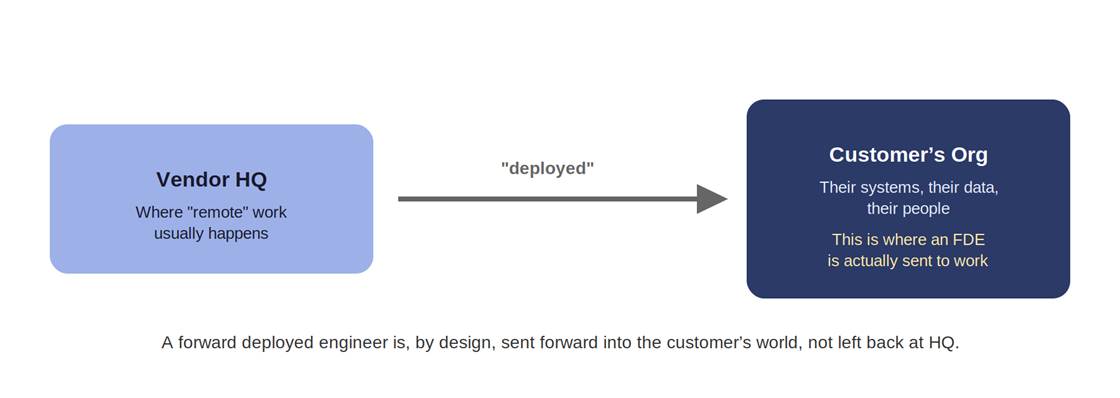
The whole answer is in the name: an FDE is sent forward into the customer's world, not left at HQ.
Build an AI-First Career, Master the Complete Skillset
Choose from our industry-leading programs designed for career success
Modern Software and AI Engineering Program
Master full-stack development with AI integration


 +1000 more
Modern Data Science and ML with specialisation in AI
Advanced data science techniques with AI specialization
+1000 moreAdvanced AIML with Specialisation in Agentic AI
Deep dive into AIML with focus on Agentic systems
+1000 moreDevOps, Cloud & AI Platform Engineering
Build and manage AI-powered cloud infrastructure
+1000 moreAI Engineering Advanced Certification by IIT-Roorkee
Premier AI engineering certification from IIT-Roorkee

AI Forward Deployed Engineer Program
Full-stack engineering, production AI and client-facing consulting
+1000 moreRemote vs Hybrid vs On-Site: How It Varies by Company
This is the thing job boards don't tell you: "FDE" isn't one job, so "is it remote?" genuinely depends on which company is saying it.
| Company type | Typical location model | Travel | Why |
|---|---|---|---|
| Classic on-site FDE shops (Palantir-style) | Mostly on-site, embedded at the client | High | The model is built entirely on being physically embedded |
| AI labs with deployment orgs (OpenAI-style) | Hybrid, project-dependent | Moderate to high | Intensive on-site sprints, remote between engagements |
| SaaS/product companies using the title loosely | Hybrid or remote-first | Low to moderate | Closer to technical account management than true field deployment |
| Startups and services firms adopting the label | Varies widely | Varies widely | The title means very different things here; read the JD carefully |
Both ends of this table are grounded in how the companies themselves describe the work. Palantir's own engineering writing on the FDE model, and OpenAI's own announcement of its Deployment Company, both describe FDEs as engineers who work inside the client organisation itself, not from a desk at the vendor's office. Wikipedia's entry on the role covers the same origin if you want a neutral third read.
The honest takeaway: read the job description, not the title. If you want to see how the same title can mean genuinely different jobs depending on the employer, how the same job title can mean different things at different companies, goes deeper into that specific reality.
SCALER | 12 MONTH PROGRAM
AI Forward Deployed
Engineer Program
Full-stack engineering, production AI, and client-facing consulting — built around a real client engagement you run from first call to production scale.
ENROLL NOWHiring from this program





How to Read a "Remote" Forward Deployed Engineer Job Posting
A "remote" tag on an FDE listing can mean several different things, and it's worth learning to tell them apart before you get excited about one.
• Does it say "remote" but also list a travel expectation like "up to 50% travel"? That's not remote in any normal sense of the word.
• Is "remote-first" paired with "must be based near a major client hub"? That's really hybrid wearing a remote label.
• Does the actual responsibilities section describe embedded on-site work despite the remote tag up top? Trust the responsibilities, not the tag.
• Is the company a classic on-site FDE shop that's suddenly advertising a remote req? Worth a direct question in the first interview.
• Does it genuinely say fully remote with zero travel for a role literally called "forward deployed"? Read the fine print carefully before you get excited.
Once you've sorted a real listing from a misleading one, a practical guide to landing a tech job covers the actual application and interview process from there.
Is a Remote FDE Role Realistic in India?
Keep this honest and short, because India relevance here is genuinely low. FDE roles in India are limited and concentrated, mostly the local offices of global companies and a handful of startups, and they skew on-site or hybrid, not fully remote. The remote-FDE search itself is largely a global or US remote-jobs query. Most Indian FDE seats also sit at a similar career stage to how software engineering careers usually progress more broadly, meaning experienced engineers rather than freshers. Don't expect a large remote market here, and be skeptical of any listing claiming otherwise without a verified posting to back it up.
So, Should the "Remote" Question Change Whether You Want This Role?
If fully remote work is non-negotiable for your life right now, the FDE role is probably a poor fit, and that's genuinely worth knowing before you apply, not after you've accepted an offer and booked your third flight of the month. If you're energised by being on the ground with customers, the travel and on-site work are the actual point of the job, not an unfortunate price you pay for it. Neither answer is wrong, they just describe different people. What the day-to-day and work-life balance of an FDE actually looks like weighs the travel and on-site reality against lifestyle in a lot more depth than this page has room for.
Check Out These Related Reads on the FDE Role
How Scaler Transformed Careers in Different Fields
Scaler learners achieved 2.5x salary growth with average post-Scaler CTC reaching ₹23L.
 Google
 Amazon
 Microsoft
 Flipkart
 Adobe1200+ more
FAQs
Do forward deployed engineers work remotely?
Usually not. The role is client-facing by design, mostly on-site or hybrid with travel, though some remote or hybrid roles do exist at certain companies. Read the specific job description rather than assuming the title guarantees remote work.
Do forward deployed engineers travel a lot?
Often yes, especially at classic on-site FDE companies. Travel varies a lot by company and project phase, so treat any specific percentage you see quoted online with suspicion unless it's attributed to a named source.
Turn Learning into Career Growth
What does "forward deployed" mean?
It means the engineer is sent to work at or inside the customer's organisation, rather than from the vendor's office. That's the entire reason the role is rarely fully remote, the name describes exactly where the work happens.
Is there such a thing as a remote forward deployed engineer job?
Yes, but they're the exception rather than the norm. Remote is most realistic in post-launch support phases, cloud-deployed products, or at companies using the FDE title loosely for what's really an account-management role.
Why isn't the forward deployed engineer role remote?
Because the hard part of the job, messy client data, legacy systems, undocumented workflows, usually can't be solved from a vendor's HQ. Companies deliberately put an engineer on site specifically to solve that problem in person.
Are there remote FDE jobs in India?
Limited. FDE roles in India are few and skew on-site or hybrid at global companies' local offices. Fully remote FDE roles are rare here, so don't expect a large remote market to exist yet.
Curious where a client-facing engineering path could take you? The forward deployed role sits at the crossroads of strong engineering and real customer work. If you're weighing whether that kind of career fits you, it's worth understanding the fundamentals first, start with an honest look at whether software engineering is a good career for you.




