How to Become an Agentic AI Engineer in 2026
An agentic AI engineer builds AI systems that can act on their own, agents that reason through a multi-step task, choose and call tools, remember context, and work toward a goal with minimal human hand-holding, instead of just answering one prompt at a time. A chatbot responds; an agent does, it can plan, use a search API, write to a database, and check its own work before handing it back to you. This page covers what the role actually does, how it differs from the roles you already know, the full skills stack, a phased path, real portfolio projects, and pay in India. If you want the foundational piece first, how AI agents actually work is worth reading alongside this one.
Worth being upfront about how new this title actually is. "Agentic AI engineer" barely existed as a job posting two years ago, the tool stack underneath it changes every few months, and the boundaries with a plain "AI engineer" role are genuinely fuzzy even inside the same company. That's not a reason to skip this page, it's the reason this page exists: everyone else writes as if the path is already settled, and it isn't. The durable part is the skills, agent design, evaluation, production discipline, not any single framework you happen to memorise this quarter.
What Does an Agentic AI Engineer Actually Do?
The real work, day to day: designing an agent's control flow, plan, act, observe, repeat, wiring up tool and function calling, giving the agent memory, connecting it to your own data through RAG, chaining or coordinating multiple agents, adding guardrails and a human-in-the-loop checkpoint, then evaluating and monitoring the thing once it's actually running. Three concrete example builds to make this less abstract: a research agent that browses and summarises sources with citations, a customer-ops agent that reads support tickets and takes real actions like issuing a refund, and a coding agent that works over a repository, writing and testing changes. The layers of an agentic AI system covers this control-flow design in real depth if you want the architectural companion.
How Is an Agentic AI Engineer Different From a GenAI, AI, or ML Engineer?
This is the most important section on this page, probably the reason you searched for it. These roles genuinely overlap, and job titles get used loosely at most companies, but the centre of gravity of each one differs in a specific, describable way.
| Role | Core job | Typical output | Signature skills |
|---|---|---|---|
| ML engineer | Trains and deploys models on data | Prediction models, data pipelines | Maths, modelling, MLOps |
| AI engineer | Builds applications on top of models and APIs | AI-powered product features | Software engineering plus model and API integration |
| GenAI engineer | Builds apps around LLMs, chat, RAG, content | LLM apps, RAG systems | Prompting, RAG, LLM APIs |
| Agentic AI engineer | Builds autonomous, tool-using, multi-step agents | Agents and multi-agent systems | Agent frameworks, orchestration, tool calling, evaluation |
The key message worth actually remembering: agentic AI engineering is the newest layer on this list. It assumes GenAI-engineer skills, prompting, RAG, working with LLM APIs, and adds autonomy, tools, orchestration, and production reliability on top. Be honest with yourself that the boundaries here are genuinely fuzzy and titles vary a lot company to company. If you want the fuller version of the AI-engineer branch specifically, the broader AI engineer roadmap covers it in depth, and how RAG differs from agentic AI is worth reading since RAG is a component agents use, not a synonym for the same thing.
The Agentic AI Engineer Skills Stack
Be honest going in: not all of this is day-one material. It builds, and skipping ahead usually just means backtracking later.
1. Programming Foundations, Python First
Python, working comfortably with APIs and JSON, basic async patterns, and Git. This is the non-negotiable base everything else sits on. If you can't call an API and parse the response confidently, agent frameworks will feel like magic instead of tools you actually control.
Build an AI-First Career, Master the Complete Skillset
Choose from our industry-leading programs designed for career success
Modern Software and AI Engineering Program
Master full-stack development with AI integration


 +1000 more
Modern Data Science and ML with specialisation in AI
Advanced data science techniques with AI specialization
+1000 moreAdvanced AIML with Specialisation in Agentic AI
Deep dive into AIML with focus on Agentic systems
+1000 moreDevOps, Cloud & AI Platform Engineering
Build and manage AI-powered cloud infrastructure
+1000 moreAI Engineering Advanced Certification by IIT-Roorkee
Premier AI engineering certification from IIT-Roorkee

AI Forward Deployed Engineer Program
Full-stack engineering, production AI and client-facing consulting
+1000 more2. LLMs and Prompt Engineering
How LLMs actually work at a working level, prompting technique, structured outputs, context windows, and the cost and latency trade-offs between models. Learning large language models from scratch is the deeper companion for this specific foundation.
3. RAG and Working With Data
Embeddings, vector databases, retrieval, and grounding an agent in your own real data rather than letting it answer from memory alone. This is where a lot of agents quietly go wrong if skipped or rushed.
4. Agent Frameworks
LangGraph and LangChain, CrewAI, and AutoGen. Learn one well before sampling the others, LangGraph is the safest first choice for most people right now, since it tends to make the others easier to understand once you've internalised how it thinks about state. A closer look at agent frameworks goes deeper on how each one actually differs, and LangGraph's own official documentation is worth working through directly rather than only reading about it secondhand.
5. Tool Use, Function Calling, and Orchestration
Giving agents tools, function and tool calling, chaining steps together, multi-agent coordination, memory in both its short-term and long-term forms, and planning loops that don't quietly drift off task. Anthropic's own engineering guide to building effective agents is genuinely one of the best primary sources on this specific skill, drawn from watching dozens of real teams build agents in production, and it draws a distinction between predictable "workflows" and true model-driven "agents" that's worth internalising early.
6. Agent Protocols (MCP, A2A)
The emerging standards for connecting agents to tools and to each other. Say this plainly, because it's true: this layer is genuinely new and still evolving. How MCP connects agents to tools and data is the exact technical companion for this, the newest and least-documented skill on this whole list, and the protocol's own documentation describes it plainly as trying to be the "USB-C for AI applications."
7. Evaluation and Observability
How you actually test an agent, which is genuinely harder than testing normal code because agents are non-deterministic. Tracing, observability tooling in the style of LangSmith, guardrails, and human-in-the-loop checkpoints all live here. This is quietly one of the most hireable, least-crowded skills on this entire list.
8. Deployment and LLMOps
Packaging, serving, monitoring, cost control, and safety once the thing is actually live. This is where "it works in my notebook" turns into a real system other people depend on, and it's the phase most self-taught learners skip entirely, which shows up immediately in interviews. An interviewer who asks "what happens when this agent's tool call times out in production" is testing exactly this phase, and a confident, specific answer here often matters more than a clever demo.
A Phased Roadmap: From Zero to Production Agents
Four clear phases. If you want the granular, week-by-week version of this same path, the full agentic AI roadmap lays it out in that level of detail.
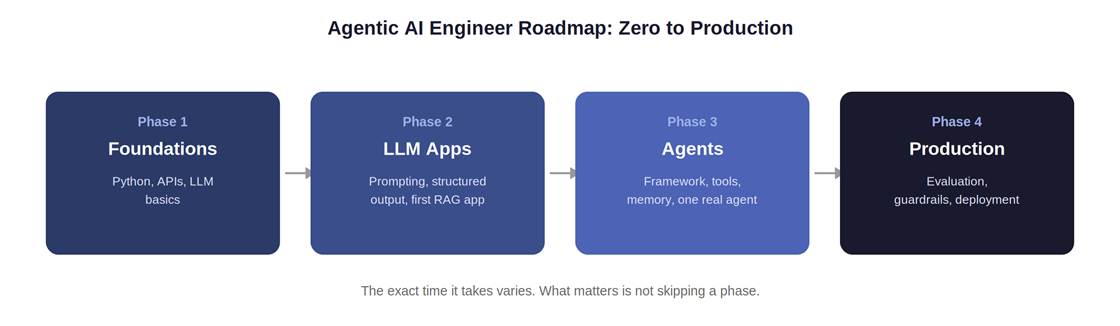
Four phases, in order. Skipping one usually just means repeating it later, slower.
Video: Complete Agentic AI Roadmap 2026 | Skills & Salary — walks through this same phased path plus the salary picture, if you'd rather watch it than read it.
Phase 1: Foundations
Python, APIs, basic software habits, and a working mental model of what an LLM actually is. "Done" looks like: you can call an LLM API yourself and build a small script around it without following a tutorial line by line.
How Scaler Transformed Careers in Different Fields
Scaler learners achieved 2.5x salary growth with average post-Scaler CTC reaching ₹23L.
 Google
 Amazon
 Microsoft
 Flipkart
 Adobe1200+ more
Phase 2: LLM Apps
Prompting properly, structured outputs, and your first real RAG app. "Done" looks like: you've built a working RAG chatbot over your own documents, not someone else's tutorial dataset.
Phase 3: Agents
Pick one framework, LangGraph or LangChain, and go deep. Add tools, memory, and multi-step control flow. Build a single autonomous agent first, then a simple multi-agent workflow once that works reliably. "Done" looks like: an agent that genuinely plans and uses tools to finish a real task, not a demo you had to babysit.
Phase 4: Production
Evaluation, observability, guardrails, deployment, and real attention to cost and latency. "Done" looks like: an agent you'd actually let a stranger use, with monitoring in place and a human-in-the-loop safety net for anything that could go wrong.
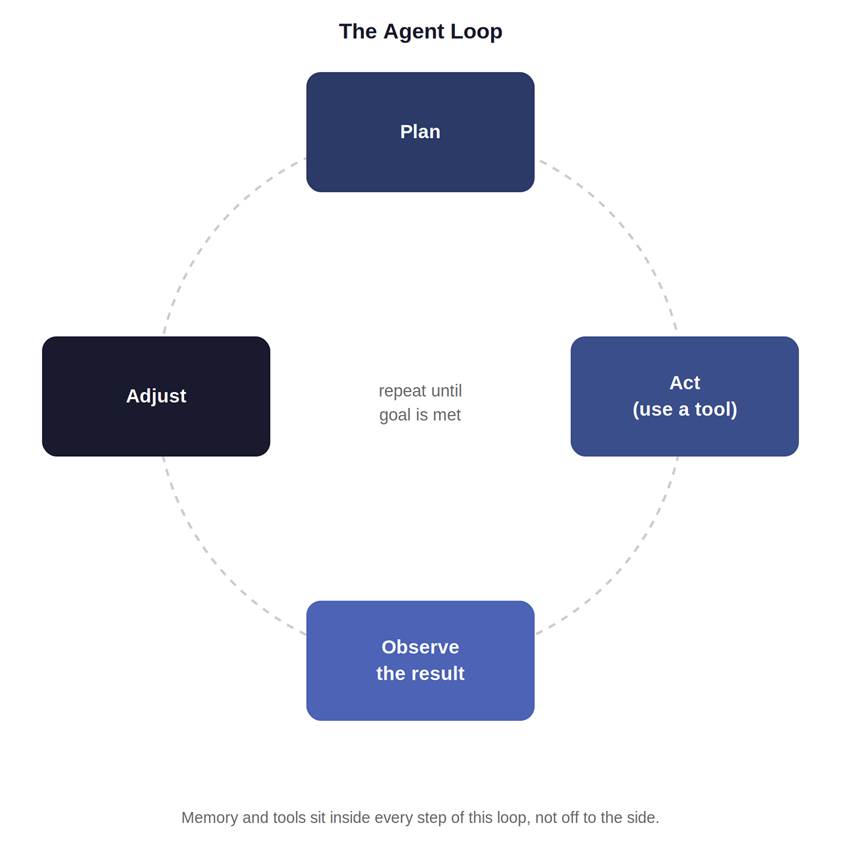
The plan, act, observe, adjust loop underneath almost every agent you'll ever build.
Portfolio Projects That Prove You Can Build Agents
Recruiters for this role want to see agents you actually shipped, not a certificate. Build these in roughly rising order of difficulty.
• A research assistant agent that browses, summarises, and cites its sources, demonstrates tool use plus real reasoning.
• A customer-support or ops agent working over real documents, demonstrates RAG, taking actions, and guardrails together.
• A coding agent that works over a small repository, demonstrates planning plus tool calling in a genuinely messy environment.
• A multi-agent workflow, a planner, a worker, and a reviewer, demonstrates real orchestration, not just one agent talking to itself.
• A deployed agent with an actual evaluation dashboard, demonstrates production discipline and observability, the thing almost nobody's portfolio has.
Practical tip that actually matters: ship them publicly, GitHub plus a short write-up or demo video, and document why you made each design choice. That's the signal that genuinely separates you from someone who followed the same five tutorials everyone else did. Generative AI projects that get you hired is a useful companion project bank if you want more ideas at each difficulty level.
Agentic AI Engineer Salary and Demand in India
A straight answer, since this is why a good chunk of you actually clicked through. Because the title itself is new, "agentic AI engineer" pay usually tracks senior AI or GenAI-engineer bands rather than having its own fully settled range yet. For context, India's broader AI engineer band runs roughly from 6 to 32 lakh annually depending on experience and company, with agentic-specific skills commanding a real premium on top of that because so few people can actually do this work well right now. Detailed AI engineer salary trends in India has the fuller breakdown by experience level and company type.
| Experience level | Indicative annual range (INR) | Notes |
|---|---|---|
| 0 to 2 years | 8 to 18 lakh | Usually hired as an AI or GenAI engineer; agent skills are a strong differentiator |
| 2 to 5 years | 18 to 35 lakh | Where dedicated "agentic" responsibilities start showing up explicitly in job descriptions |
| 5+ years | 35 lakh and above | Senior AI engineering bands; agent-orchestration and production experience command a real premium |
Demand drivers worth knowing: enterprises are actively moving from plain chatbots to genuine agents, and the MCP and tooling layer is maturing fast enough to make that shift practical rather than experimental. Be candid with yourself that it's still early and fast-moving, this isn't a settled career track with a fixed ladder yet, it's a genuinely emerging one. That said, the direction is unambiguous: the same forces pushing enterprises toward agentic systems are the ones pushing pay upward for anyone who can actually ship one reliably, not just demo one.
Turn Learning into Career Growth
How to Get Hired as an Agentic AI Engineer
Build and show real agents, your portfolio beats certificates every time in this specific field. Contribute to open-source agent projects if you can, it's a genuinely fast way to get real feedback from people better than you. Write about what you built and why, a short blog post explaining a design trade-off you made is worth more to a hiring manager than another line on a resume. Target companies actively deploying agents rather than ones just talking about AI in their careers page, the job description itself usually gives this away if you read past the buzzwords. Prepare for interviews that test system design for agents specifically, memory design, tool selection, failure handling, evaluation approach, far more than they test LeetCode-style algorithm puzzles. Be honest with yourself that many roles right now are still labelled "AI engineer" or "LLM engineer" rather than "agentic AI engineer" specifically, apply to those too, and let your agent portfolio do the actual talking in the interview. The path to becoming an AI engineer is worth reading too, since a meaningful share of agentic roles are advertised under that broader title.
FAQs
What does an agentic AI engineer do?
Builds autonomous, tool-using, multi-step agents. The real day-to-day work is designing control flow, memory, and tool integration, then evaluating and monitoring the agent once it's actually running.
What is the difference between an agentic AI engineer and an AI engineer?
Agentic AI engineering adds autonomy, tool use, orchestration, and production reliability on top of the skills a general AI or GenAI engineer already has. The roles overlap; agentic is the newer, narrower layer.
What skills do I need to become an agentic AI engineer?
Python, LLM fundamentals and prompting, RAG, comfort with at least one agent framework, tool calling and orchestration, evaluation, and deployment. Roughly in that order.
Do I need to be an ML engineer first?
No. A software or Python background plus LLM application skills is the far more common route into this role. Deep model training expertise is genuinely optional for most agentic AI engineering work.
How long does it take to become an agentic AI engineer?
Honestly, it varies a lot. Roughly 6 to 12 months of focused, project-based learning is realistic if you already code comfortably going in.
Which agent framework should I learn first?
Pick one rather than sampling all of them at once. LangGraph or LangChain is the safe default, and build real agents with it before branching out to CrewAI or AutoGen.
Is agentic AI engineering a good career in 2026?
Early and genuinely fast-moving, but demand and pay are both strong right now specifically because the skills are still scarce. Be honest with yourself that this is a new, actively evolving field, not a settled one yet.
Ready to turn this roadmap into a real study plan? See exactly what to learn and in what order in Scaler's agentic AI syllabus.