FDE vs Prompt Engineer: Why One Role Is Growing and the Other Is Fading
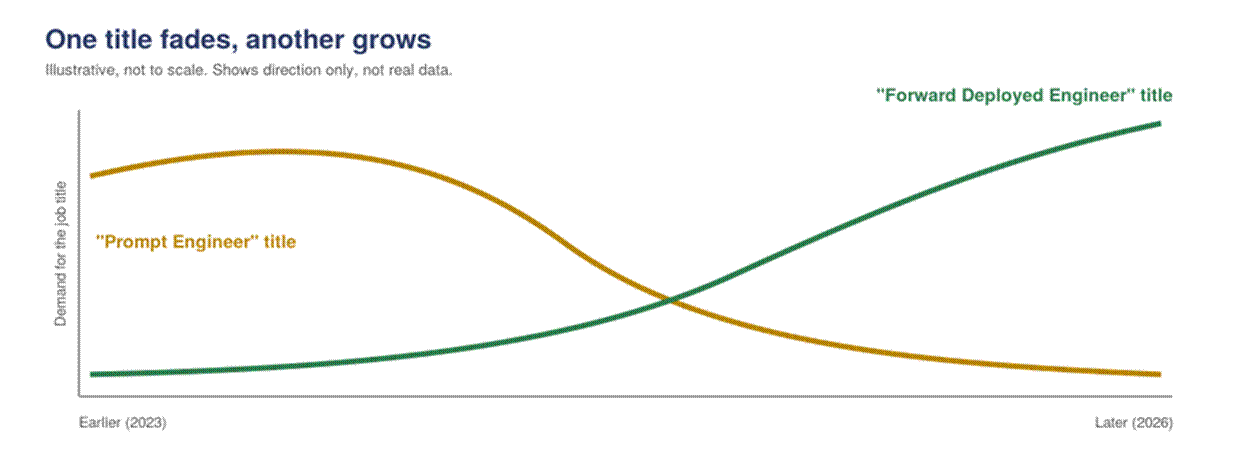
In 2023, “prompt engineer” was one of the most talked-about new jobs in tech. By April 2025, The Wall Street Journal was reporting the role as “basically obsolete”. Meanwhile, postings for forward deployed engineers kept multiplying, and many people who took a prompt engineering course in 2023 or 2024 are now wondering what that means for them.
So what happened? The title faded because the skill became part of other jobs, and the FDE is one of the jobs that absorbed it. If you are weighing forward deployed engineer vs prompt engineer as a career, this guide gives you a side-by-side, the evidence, pay in India and a plan to move from one to the other. (New to the term? Here is what a Forward Deployed Engineer is.)
Short answer: A prompt engineer designs and tests the instructions given to AI models. A Forward Deployed Engineer builds and ships complete AI solutions inside a customer’s systems: integration, data, evaluation and deployment. Prompting is now one skill within roles like FDE and AI engineer, which is why the standalone prompt engineer title is fading while FDE hiring grows.
What does a prompt engineer actually do?
A prompt engineer designs, tests and iterates on prompts and system instructions. The work includes building prompt templates and few-shot examples, checking outputs for quality and safety, and documenting what works.
The title showed up mostly in 2023 and 2024, at AI labs, AI startups and content or marketing teams. Backgrounds were varied: writers, linguists, domain experts and some developers. Many roles needed little or no coding, which is a big reason the title was easy to absorb into other jobs.
If you want the full picture of how people became prompt engineers, we cover it separately.
The more technical modern version is context engineering: managing what goes into a model’s context, such as retrieved data, tools and memory. It is the successor skill, and it is closer to software engineering than to copywriting.
What does a Forward Deployed Engineer do differently?
An FDE embeds with a customer and ships working software there. That means understanding the business problem, integrating with the customer’s data and systems, building the AI workflow (prompts included), setting up evaluation, deploying and handing over. Prompts are one input. The FDE owns the outcome.
Here is the contrast. A prompt engineer improves how a support bot answers refund questions. An FDE connects that bot to the customer’s order system, makes sure it cannot refund the wrong order, measures its accuracy against real tickets, and gets the customer’s ops team to trust it.
That is why the skills a Forward Deployed Engineer needs go well beyond prompting. Palantir’s own Forward Deployed Software Engineer listing asks for a strong coder with proficiency in languages such as Python, Java, C++ or TypeScript/JavaScript.
SCALER | 12 MONTH PROGRAM
AI Forward Deployed
Engineer Program
Full-stack engineering, production AI, and client-facing consulting — built around a real client engagement you run from first call to production scale.
ENROLL NOWHiring from this program





Build an AI-First Career, Master the Complete Skillset
Choose from our industry-leading programs designed for career success
Modern Software and AI Engineering Program
Master full-stack development with AI integration


 +1000 more
Modern Data Science and ML with specialisation in AI
Advanced data science techniques with AI specialization
+1000 moreAdvanced AIML with Specialisation in Agentic AI
Deep dive into AIML with focus on Agentic systems
+1000 moreDevOps, Cloud & AI Platform Engineering
Build and manage AI-powered cloud infrastructure
+1000 moreAI Engineering Advanced Certification by IIT-Roorkee
Premier AI engineering certification from IIT-Roorkee

AI Forward Deployed Engineer Program
Full-stack engineering, production AI and client-facing consulting
+1000 moreIs prompt engineering dead? What the evidence actually says
The title is fading. The skill is not. Here is what we can source.
• The Wall Street Journal, April 2025: as reported by TechRepublic, prompt engineering, once hailed as the next big tech career, is now “basically obsolete” as a role. Companies were instead looking at roles such as AI trainers, AI data specialists and AI security specialists, drawn from Microsoft research on new roles.
• Microsoft’s Jared Spataro: in the same coverage, he says generative AI can ask follow-up questions or request feedback, so users need to prompt it less precisely.
• Microsoft’s 2025 Work Trend Index: 78% of leaders are considering hiring for new AI roles, per the report. That figure is about new AI roles in general, not prompt engineers. It shows demand shifting to new role types. That is the pattern to take away: employers are still hiring for AI work, just under different titles.
Why did it fade? Four reasons, based on how the tools changed rather than on a single study:
• Models got better at understanding plain instructions.
• Tools now optimise prompts automatically.
• Companies found prompts were rarely the bottleneck. Integration, data and evaluation were.
• Prompting became something every developer and product manager does.
The balance line: the skill is more valuable than ever. It is just not a job on its own. Prompt and context engineering now appear inside AI engineer, applied AI and FDE job descriptions.
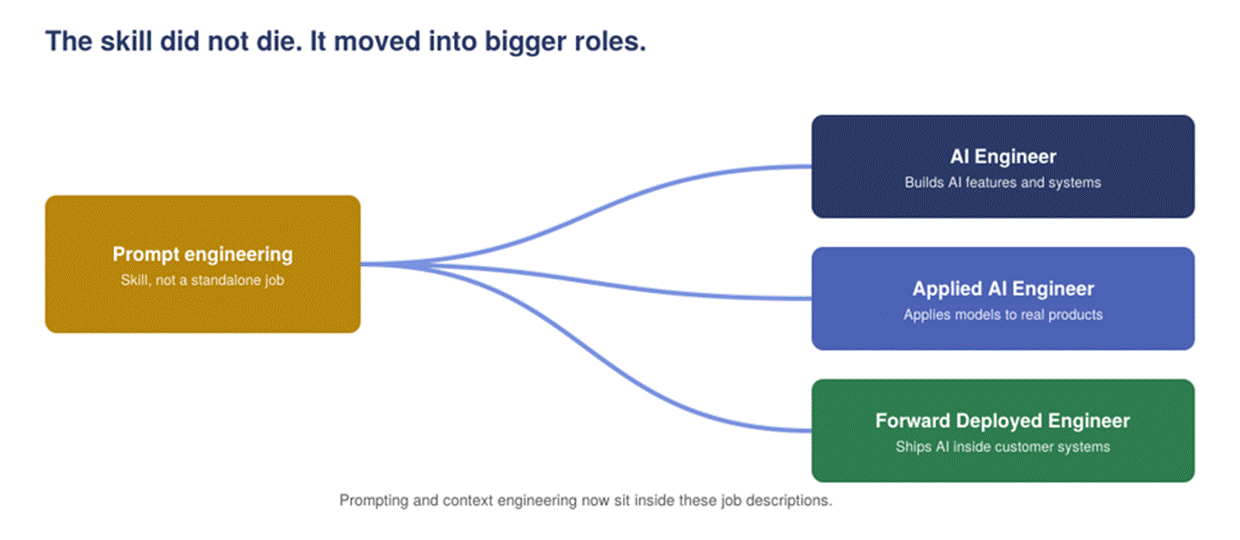
The skill still matters. If you are building it, follow the prompt engineering roadmap, then add the engineering around it.
Why is Forward Deployed Engineer hiring growing?
Two datasets point the same way. Bloomberry, analysing Revealera data on about 1,000 postings, reported that FDE job postings grew 1,165% between January to October 2024 and the same period in 2025 (Bloomberry analysis).
Indeed data reported by Business Insider shows 5,330 FDE postings in April 2026 against 643 a year earlier, an increase of about 729%.
Read these carefully. They count job postings from a small starting base, not filled roles. Bloomberry’s piece does not publish the absolute counts behind its percentage. Treat them as a direction, not a headcount.
Another way to read the growth: a prompt can be written in an afternoon, but an AI system that works inside a customer’s order system, data warehouse and approval process takes sustained engineering. That is the gap FDEs are hired to close, and it is why customers pay for people who sit with them.
The reasons behind the growth are easier to explain than the numbers. Companies bought AI and struggled to get it into production. FDEs close that gap. AI labs, startups and Palantir, whose model long predates the current wave, hire FDEs to make deployments succeed.
Could “Forward Deployed Engineer” be the next overhyped title?
It is a fair question. Writer Joe Procopio, in a July 2026 piece, argues that FDEs are not repackaged prompt engineers: they implement and integrate existing AI inside customer workflows, while prompting was a weak input method that he expects to fade. He also warns that companies may use FDEs as a bolt-on fix for AI rollouts that went wrong without governance. New AI titles do tend to get hyped, and some postings labelled FDE are really solutions or support roles.
Still, FDE is structurally different from the prompt-engineer wave, for three reasons:
• It is rooted in a model Palantir has used for years, not a 2023 invention.
• It requires core software engineering, a durable and transferable skill even if the title changes.
• The work, deploying software inside messy customer environments, does not go away when models improve. Better models create more of it.
We looked at this in detail in our piece on whether AI will replace forward deployed engineers.
In practice, ask any job posting three questions. Does it expect production code? Does it expect you to measure quality with real data? Does it put you in front of customers or their systems? A role that says yes to all three will outlast a title trend.
The honest bottom line: bet on the skills, not the title. If “FDE” gets renamed, integration, evaluation and customer-facing engineering will still transfer.
Which pays more in India: FDE or prompt engineer?
The two roles are hard to compare fairly, because the data comes from different samples. We use only sourced figures and show dates.
For prompt engineers, Glassdoor India lists average total pay of about ₹6.6 lakh a year, based on 50 salaries across all experience levels. See also our guide to prompt engineering salaries in India.
For FDEs, we use the ranges on our Forward Deployed Engineer salary and responsibilities page, so figures stay consistent across the site. Those are market estimates for top-tier product companies in 2026.
| Role | Typical India range (total pay) | Source and as-of date |
|---|---|---|
| Prompt engineer | About ₹6.6 LPA average (base ₹4 to 9 LPA) | Glassdoor India, 50 salaries, checked 11 Oct 2026 |
| FDE, 0 to 3 years | ₹18 to 25 LPA | Scaler FDE salary page, 2026 estimates |
| FDE, 3 to 7 years | ₹30 to 65 LPA | Scaler FDE salary page, 2026 estimates |
| FDE, 7+ years | ₹65 LPA to ₹1.2 crore+ | Scaler FDE salary page, 2026 estimates |
Not a like-for-like comparison: the Glassdoor figure is an all-experience average, while the FDE ranges are estimates for top-tier product companies.
Why do FDEs tend to earn more? The skill combination is scarcer. They carry production responsibility, and the work is customer-facing, often with travel. Beyond that, we do not claim a precise gap.
Can a prompt engineer become a Forward Deployed Engineer?
Yes, and it is more realistic than it sounds. You are not starting from zero. What changes is how much of your work is engineering and how much is wording.
The honest caveat is that hiring managers look for evidence, not intent. A short, well-built project beats a long list of courses.
What carries over from prompt engineering
• Model behaviour: you already understand failure modes and where models go wrong.
• Evaluation: writing test cases and judging output quality is core FDE work.
• Communication: you can translate requirements into instructions.
• Domain knowledge: if you worked in a vertical, that is a real advantage with customers.
What you’ll need to add
| Skill | Have it from prompt engineering? | How to build it |
|---|---|---|
| Production coding (Python, reading TypeScript) | Rarely | Rebuild a prompt project as a tested app |
| APIs, data integration and SQL | Partly | Connect a model to a real database and an API |
| RAG, tool calling and agent basics | Conceptually | Build them as engineering, with tests, not just prompts |
| Deployment (cloud, containers, logging) | No | Ship one project and watch it run |
| Customer-facing delivery | Sometimes | Practise scoping, demos and handover |
How Scaler Transformed Careers in Different Fields
Scaler learners achieved 2.5x salary growth with average post-Scaler CTC reaching ₹23L.
 Google
 Amazon
 Microsoft
 Flipkart
 Adobe1200+ more
A realistic 6-month transition plan
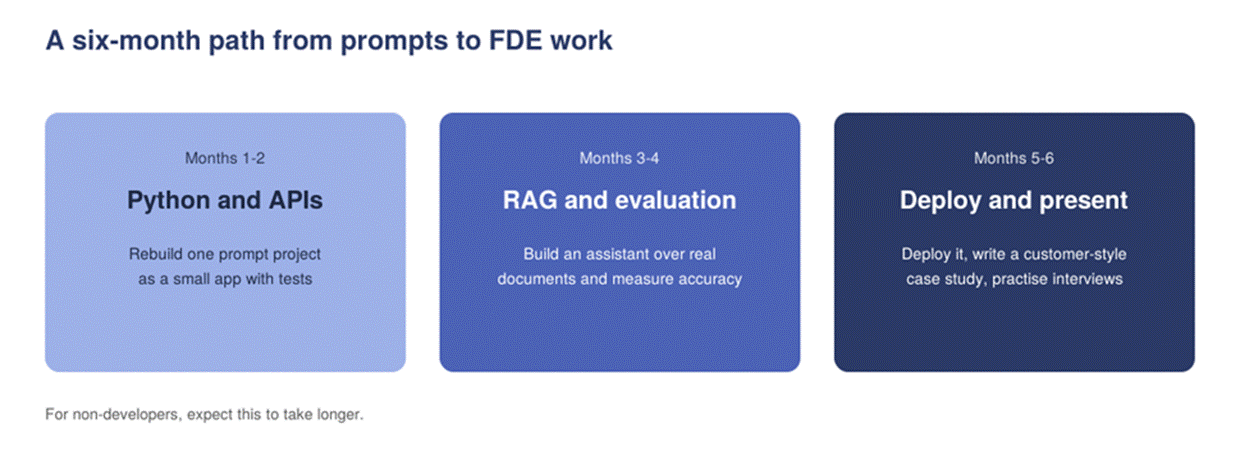
• Months 1 to 2: Python and APIs. Rebuild one of your prompt projects as a small app with tests.
• Months 3 to 4: RAG plus evaluation. Build an assistant over real documents and measure its accuracy.
• Months 5 to 6: deploy it, write a customer-style case study and practise FDE interviews.
For non-developers, this may take longer. That is normal, and a slower pace with real projects beats a fast pace with tutorials. For the full step-by-step path to becoming an FDE, including interviews, see our guide.
Moving from prompts to production? The jump from prompt engineering to FDE work is mostly about engineering: integrating with real systems, measuring AI quality, and shipping for a customer. Scaler’s Forward Deployed Engineer course is a structured, project-based, mentor-led path built around that work. It’s worth exploring if you’d like guidance through the transition.
Which path should you choose in 2026?
| If you… | Consider |
|---|---|
| Enjoy writing, language and model behaviour, and don’t want heavy coding | Prompt and context skills inside content, product or AI-ops roles, not a standalone “prompt engineer” title |
| Already code and like building end to end | FDE (or AI engineer) |
| Like customers, ambiguity and travel | FDE specifically |
| Prefer deep, internal product work | AI engineer |
| Are a fresher | Build software fundamentals first; add prompting as a skill |
Torn between the two engineering paths? Read AI engineer vs forward deployed engineer.
FAQs
Do prompt engineers need coding?
Not always. Many early prompt engineer roles needed little coding, which is part of why the title was easy to absorb. But roles that survive increasingly expect Python, API use and evaluation scripts. If you want to move toward FDE or AI engineer work, plan to code seriously.
Turn Learning into Career Growth
What is the difference between a prompt engineer and an AI engineer?
A prompt engineer focuses on instructions and outputs. An AI engineer builds AI-powered features and systems end to end, including data pipelines, retrieval, evaluation and deployment. Prompting is one skill inside the AI engineer role, alongside software engineering and system design.
What is context engineering?
Context engineering is managing everything a model sees when it answers: instructions, retrieved documents, tool results and memory. It is the more technical successor to prompt writing, and it sits inside AI engineer and FDE work. If you already write good prompts, learning how retrieval and tools feed the context is the natural next step.
Is a prompt engineering course still worth it in 2026?
As a skill, yes. As a way to land a standalone prompt engineer job, much less so. Use a course to learn prompting basics quickly, then add Python, APIs, retrieval and evaluation so the skill is attached to a role employers are still hiring for.
Do forward deployed engineers need prompt engineering skills?
Yes. FDEs write and tune prompts as part of building AI workflows, but it is one skill among many. Integration, evaluation and customer communication usually matter more to whether a deployment succeeds, so strong prompting alone will not carry an FDE interview.
What replaced prompt engineering jobs?
Mostly broader roles: AI engineers, applied AI engineers, forward deployed engineers, and new roles like AI trainers and AI security specialists, per WSJ reporting on Microsoft research. Prompting became a baseline skill across these jobs rather than a job title of its own, and that is why the work did not disappear.
Should I still put prompt engineering on my resume?
Yes, as a skill, with evidence: a project, an evaluation set and a measured improvement. Avoid making it your whole headline. Pair it with the engineering around it, such as retrieval, APIs and deployment, so you read as someone who ships real projects, not just someone who writes instructions.